
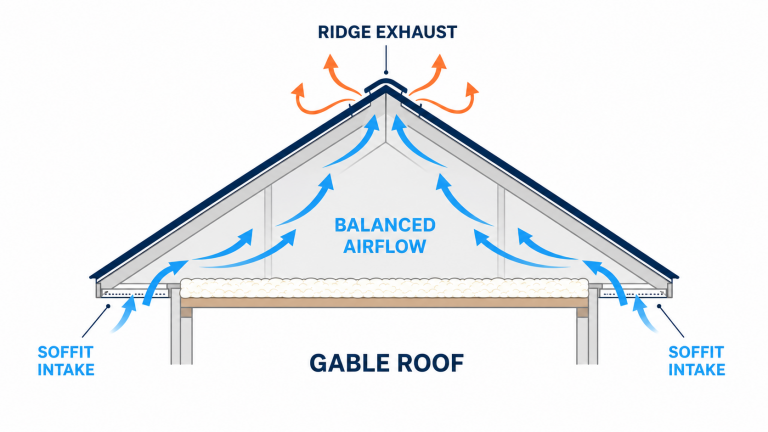
Ridge vent with soffit intake
- Gable roof with a long ridge
- Open, unfinished attic
- Room to add soffit vents
A continuous vent along the peak, fed by vents under the eaves. No moving parts and no power. We often add it during a roof replacement.
 Terra Nova Roofing & Construction
Most attic problems are airflow problems. Terra Nova installs and corrects attic fans, solar attic fans, ridge vents, box vents and soffit intake on Bloomfield homes. We check the whole attic first, then fix the path air takes from the eaves to the peak, so you are not just adding one more hole in the roof.
Licensed & insured • NJ Lic. #13VH13824700 • ★★★★★ 5-star rated on Google • Locally owned in Garfield, NJ • Free written estimates with photos • Hablamos español
Text a photo of your attic, vents or ceiling stain to 973-200-1617 and we’ll tell you what we see.
Start with the attic, not the product. Most Bloomfield colonials and capes work best with soffit intake at the eaves and a ridge vent at the peak. A solar or electric attic fan can help hip roofs and short ridges, but only with enough intake and no competing vents. Terra Nova inspects the attic and gives you a free written estimate. Call or text 973-200-1617.
Before you call anyone, you can learn a lot with a flashlight. If you can safely reach your attic hatch, look for these:
Can you see daylight or baffles where the rafters meet the outside walls? Insulation stuffed tight to the roof deck usually means no intake.
Is there a continuous slot along the ridge, a few box vents, a fan, or nothing at all? Note what you see.
In winter, frost or rust on nail tips poking through the roof deck is a sign of trapped moisture.
Dark stains, black spots or a musty smell on the decking and rafters point to long-term condensation.
Follow the bath fan ducts. If they end in the attic instead of outside, they are pumping moisture up there.
On a summer afternoon, an attic that feels like an oven is not moving enough air.
Take photos of what you find and text them to 973-200-1617. It helps us plan before we visit. Not sure what you are looking at? Read signs of poor attic ventilation.
Bloomfield gets real seasons, and a poorly vented attic causes trouble in both of them.
In summer, sun on the shingles heats the attic. If that hot air cannot escape near the ridge, it soaks down into second-floor bedrooms. Your air conditioning runs longer, upstairs rooms stay warm into the night, and shingles bake from below as well as above.
In winter, the problem flips. Warm, damp air from showers, cooking and breathing rises into the attic through gaps around light fixtures, pipes and the hatch. When it reaches the cold underside of the roof deck, it condenses or freezes. On the first sunny day that frost melts and drips, which many homeowners mistake for a roof leak. Over several winters it can stain and soften the decking.
Ice dams sit between the two. A warm attic melts snow on the upper roof, the water runs down to the cold overhang and refreezes, and the ice can back water up under the shingles. Good ventilation keeps the roof deck colder and more even, which is one part of the fix. Learn more about how attic ventilation works.
Every attic needs two things: air in low and air out high. Here is what we install to get there:
A continuous vent along the peak, fed by vents under the eaves. No moving parts and no power. We often add it during a roof replacement.
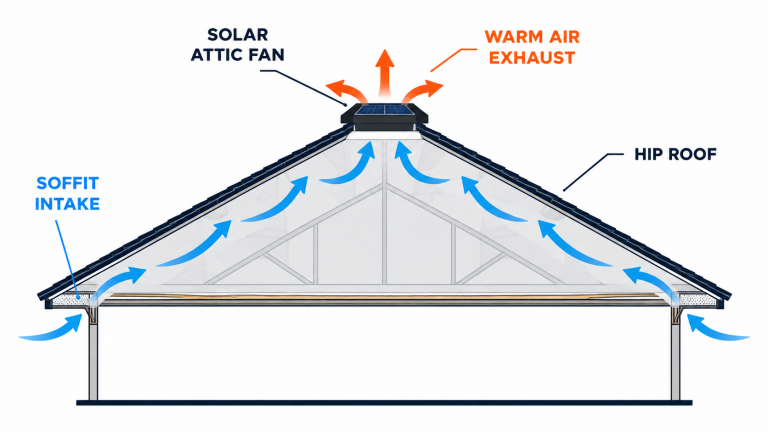
A fan with its own small solar panel. It can help where a ridge vent is too short, but it needs enough intake and should not run beside a ridge vent.
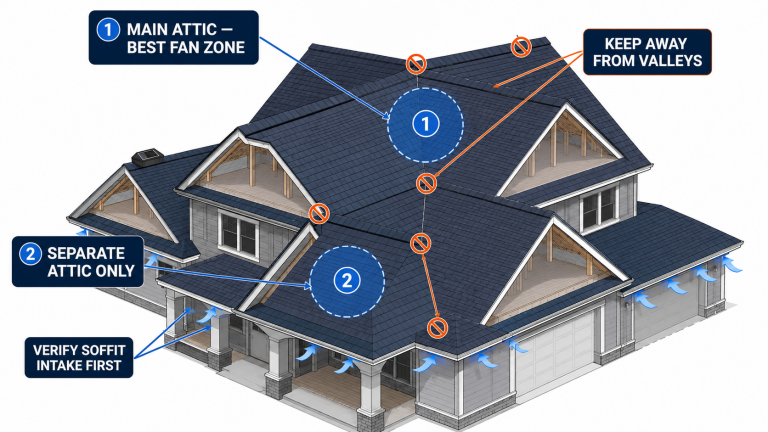
Moves a lot of air on a thermostat. Without enough intake it can pull cooled air out of the house, so we check intake before replacing one.
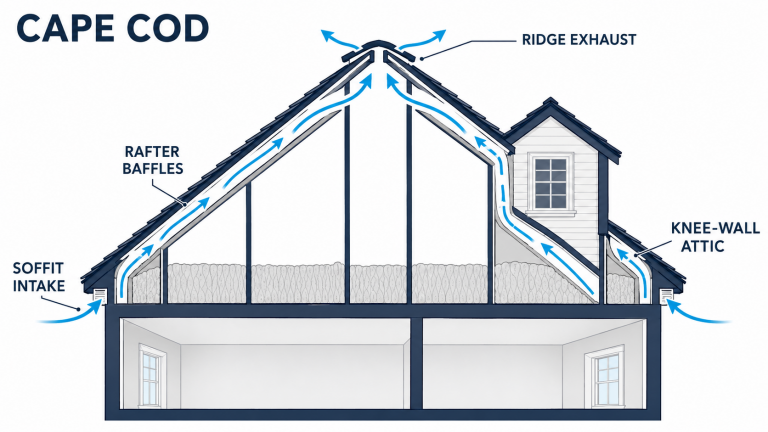
Intake is the half most attics are missing. Baffles hold insulation back so air can flow up under the roof deck.
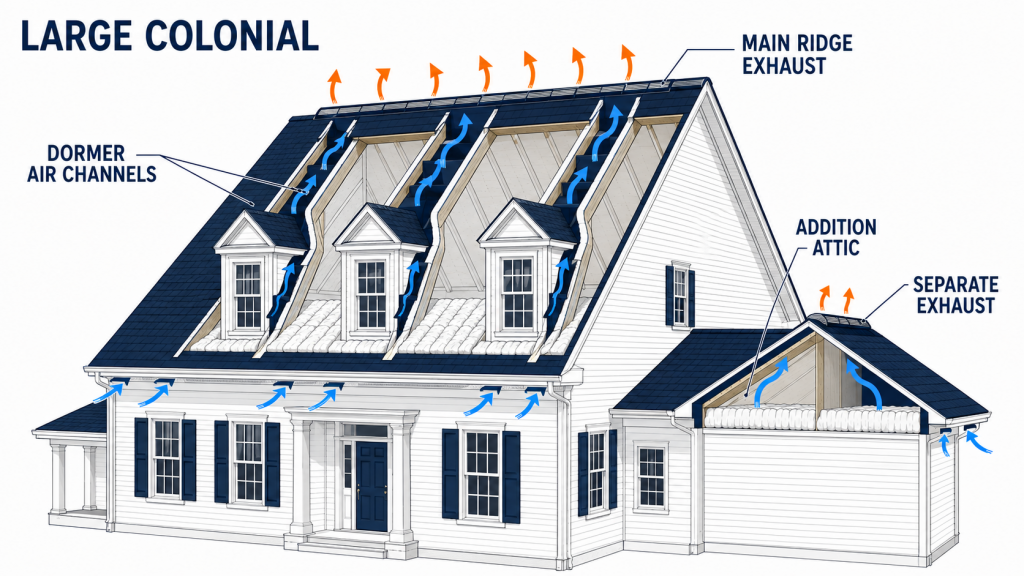
A quick look at the roof shapes we see most in Bloomfield and the usual starting plan. Your attic may differ, which is why we inspect first.
| Roof or attic type | Usual starting plan | What we check closely |
|---|---|---|
| Gable roof, open attic | Soffit intake plus ridge vent | Whether soffits are truly open |
| Hip roof | Box or hip vents, or a solar fan | Enough exhaust for the short ridges |
| Cape Cod with knee walls | Baffles and intake into each pocket | Blocked air paths behind the walls |
| Two-family, big attic | One exhaust system, not three | Old fans and box vents fighting each other |
| Cathedral or low-slope addition | A separate plan for that section | Whether there is any air space at all |
Weighing a fan against a ridge vent? See solar attic fan vs. ridge vent.
Bloomfield is one of Essex County’s older towns, with plenty of early 1900s colonials, capes, foursquares and two-family homes on blocks from Bloomfield Center and the Green to Brookdale and the streets near Watsessing Park. Many of these houses were built with little planned ventilation. Over the decades they gained insulation, finished attics, vinyl or aluminum soffits, and sometimes a second layer of shingles. Each change can quietly shut off airflow.
What we see most often in Bloomfield attics:
Because Terra Nova is based a short drive away in Garfield, we can usually get to Bloomfield quickly for an inspection. If the roof itself is near the end of its life, plan ventilation together with roof replacement in Bloomfield. For leaks or worn shingles, see roof repair in Bloomfield.
Here is how a typical Terra Nova ventilation job in Bloomfield runs, start to finish:
We look at intake, exhaust, insulation, stains, frost marks and any fans, and take photos.
We tell you whether the cause is ventilation, air leaks from the house, a roof leak or a mix.
You get a free written plan listing what gets added, opened up, closed off or removed.
Soffit vents and baffles go in or get cleared so air can enter at the eaves.
A ridge vent, box vents or a solar or electric fan is cut in and flashed to the maker’s instructions.
Old vents that would short-circuit the airflow are sealed or decked over, as agreed.
You see before and after photos and get simple tips to keep the system working.
Ventilation removes heat and moisture that reaches the attic. It works best when less of it gets there in the first place. If warm house air pours in through gaps around recessed lights, plumbing stacks, chimneys and the attic hatch, even a well-vented attic can frost up in January.
That is why our inspection looks at both sides:
We tell you which parts matter most for your home, so you can decide what to do now and what can wait. More on balancing a system: unbalanced attic ventilation.
★★★★★ 5-star rated on Google
Tell us what you are noticing and send a photo if you can. We’ll inspect the attic and roof, show you photos and give you a written estimate with the ventilation plan spelled out.
Fill this out and a member of our team will follow up within one business day.
✓ No-obligation quote · ✓ Licensed & insured · ✓ Your info is never shared
Not always. Many Bloomfield homes do best with soffit vents and a ridge vent. An attic fan can help some attics, but only with enough intake and no competing vents. We inspect first and recommend what fits.
On a gable roof with a long ridge and open soffits, a ridge vent is usually the simpler choice. On hip roofs or short ridges, box vents or a solar fan may work better. Running a fan beside a ridge vent usually causes problems.
Yes. Ridge vents, box vents and solar fans can be added to an existing roof, with new flashing and shingles around each opening. If your roof is near the end of its life, it is usually smarter to plan ventilation with the replacement.
Warm, moist house air is reaching the cold roof deck and freezing. That usually means air leaks from below plus weak ventilation. Left alone, it can stain and rot the decking.
The attic above them is likely overheating because of weak intake, blocked air paths or thin insulation. Better ventilation helps, and air sealing and insulation may help too.
Vented vinyl or aluminum soffits are sometimes installed over solid wood, or the insulation inside is packed against them. From the ground they look fine, but no air gets in. We check from inside the attic.
If it is noisy, dead or the attic still overheats, it is worth a look. Sometimes we replace it; sometimes we remove it and switch to passive vents or a solar fan, depending on your intake.
It helps by keeping the roof deck colder, but ice dams also come from warm air leaks and thin insulation. Ventilation is one part of the fix, along with ice and water barrier at the eaves.
Any opening in a roof can leak if it is installed poorly. We cut, flash and seal every vent to the maker’s instructions and check it for wind-driven rain.
It depends on the roof, the attic and what needs to be added or removed. We don’t quote prices over the phone. Terra Nova gives a free inspection and a written estimate.
Yes. We serve Essex County and nearby towns, including Glen Ridge, Montclair, Nutley, Belleville, Clifton and East Orange.
Yes. Terra Nova Roofing & Construction is licensed and insured, NJ HIC license #13VH13824700, and based in Garfield, NJ.
Nutley, NJMontclair, NJCedar Grove, NJPassaic, NJCarlstadt, NJWoodland Park, NJWood-Ridge, NJGarfield, NJElmwood Park, NJTeterboro, NJ
Updated November 2026 by the Terra Nova Roofing & Construction team, Garfield, NJ • NJ Lic. #13VH13824700
Choose an option to reach a team member.


